How to Draft a Franchise Agreement
Quick Summary
A Franchise Agreement details the operational relationship between a Franchisor (brand owner) and a Franchisee (operator). It specifies setup and ongoing royalty fees, brand and refurbishment compliance, territorial exclusivity, and tax withholding (TDS under Section 194J). This step-by-step visual guide walks you through drafting a Franchise Agreement on Founding Legals.
Commercial Agreements - Agreement Type
This agreement falls under the Commercial Agreements category on the Founding Legals Agreements page, which governs day-to-day business operations under Indian commercial law.
Understanding the Franchise Agreement
A Franchise Agreement is a commercial contract under which the owner of a brand and business model (the Franchisor) grants another party (the Franchisee) the right to operate an outlet under their trademark. To structure a legally compliant franchise in India, parties must address four key legal and regulatory requirements:
- Trademark Licensing (Trade Marks Act, 1999): The core asset licensed is the Franchisor's intellectual property. Under Sections 48 and 49 of the Trade Marks Act, 1999, the parties should register the Franchisee as a "Registered User" with the Trademark Registry to protect the trademark's validity and prevent any claims of ownership or goodwill accretion by the Franchisee post-termination.
- Territorial Exclusivity (Competition Act, 2002): Restricting other outlets within an Exclusivity Radius (e.g., 3 km) constitutes an exclusive distribution / territorial restraint under Section 3(4) of the Competition Act, 2002. The radius must be commercially reasonable and must not cause an Appreciable Adverse Effect on Competition (AAEC).
- Withholding Tax on Royalties (Income Tax Act, 1961): Franchise fees and ongoing royalties (e.g., 6% of gross sales) represent payment for technical know-how or royalty under the Income Tax Act. Under Section 194J, the Franchisee is legally required to deduct Tax Deducted at Source (TDS) at the applicable rate (usually 10%) before making payments to the Franchisor.
- Refurbishment & Brand Standards: Franchisors mandate periodic outlet renovations (e.g., every 5 years) to maintain uniform brand appearance. Refurbishment cycles must specify capital expenditure allocations clearly to prevent disputes when stores require hardware or aesthetic updates.
Step-by-Step Guide to Drafting a Franchise Agreement
Access the template: Navigate to the Agreements tab in the left sidebar. Scroll down to the Commercial Agreements section, locate the Franchise Agreement card, and click + Create.
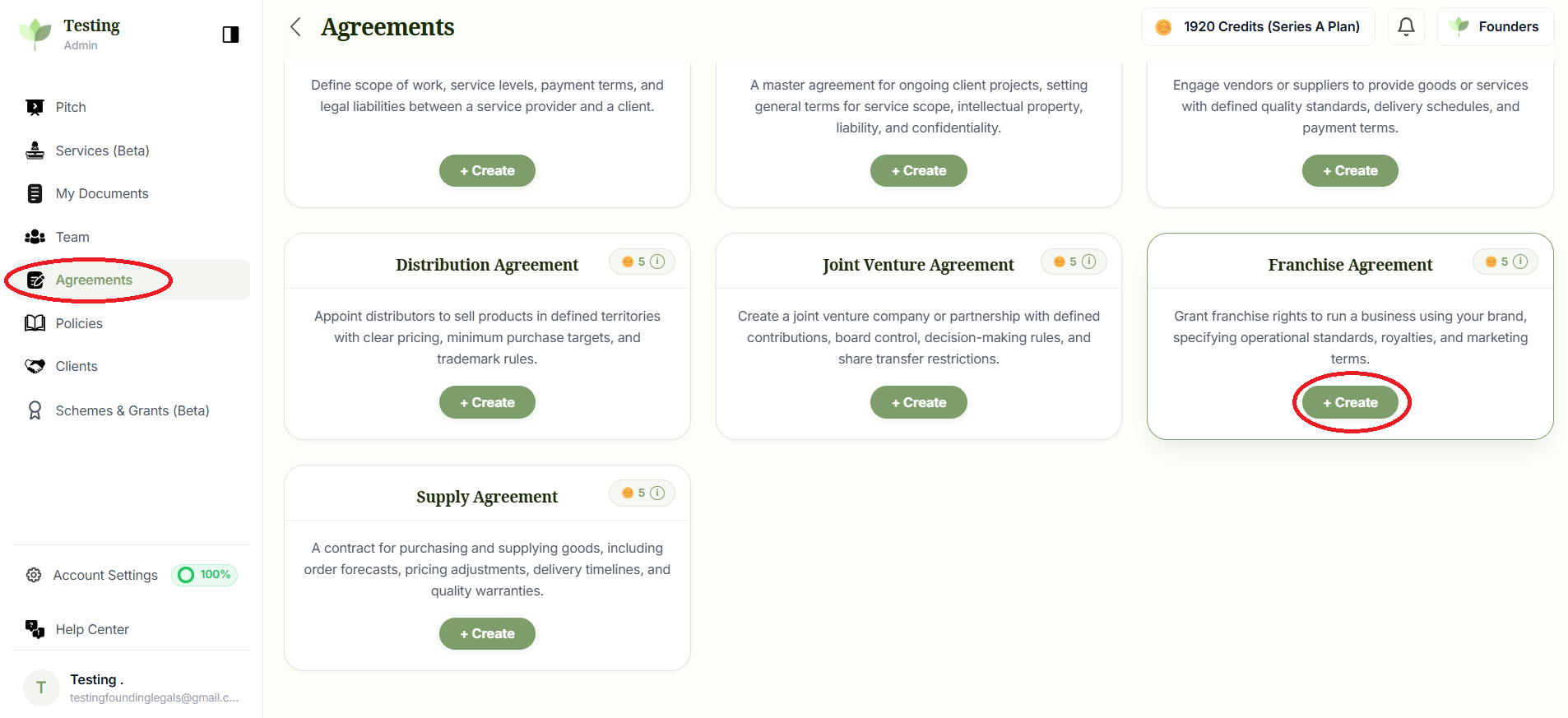
Select the Franchisee: In the Select Recipient panel on the right sidebar, search for the Franchisee's representative or click + Add new recipient.
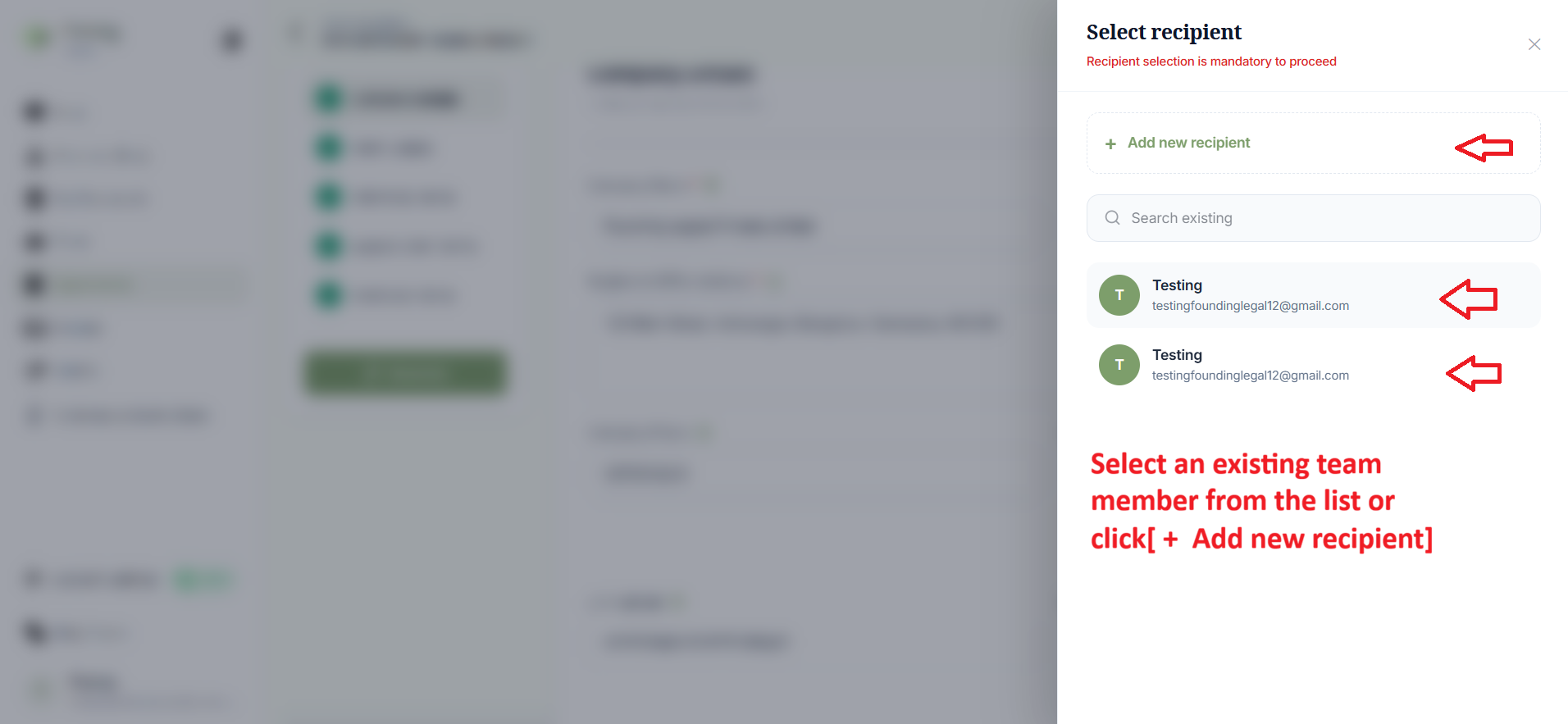
Choose terms baseline: In the Choose Agreement Terms menu, select:
- Founding Legals standard terms: Pre-populates the editor with standard franchise operation covenants, intellectual property restrictions, royalty mechanisms, and audit rights.
- Custom terms: Choose this option to upload your own custom franchise template.
Click Confirm to launch the editor.
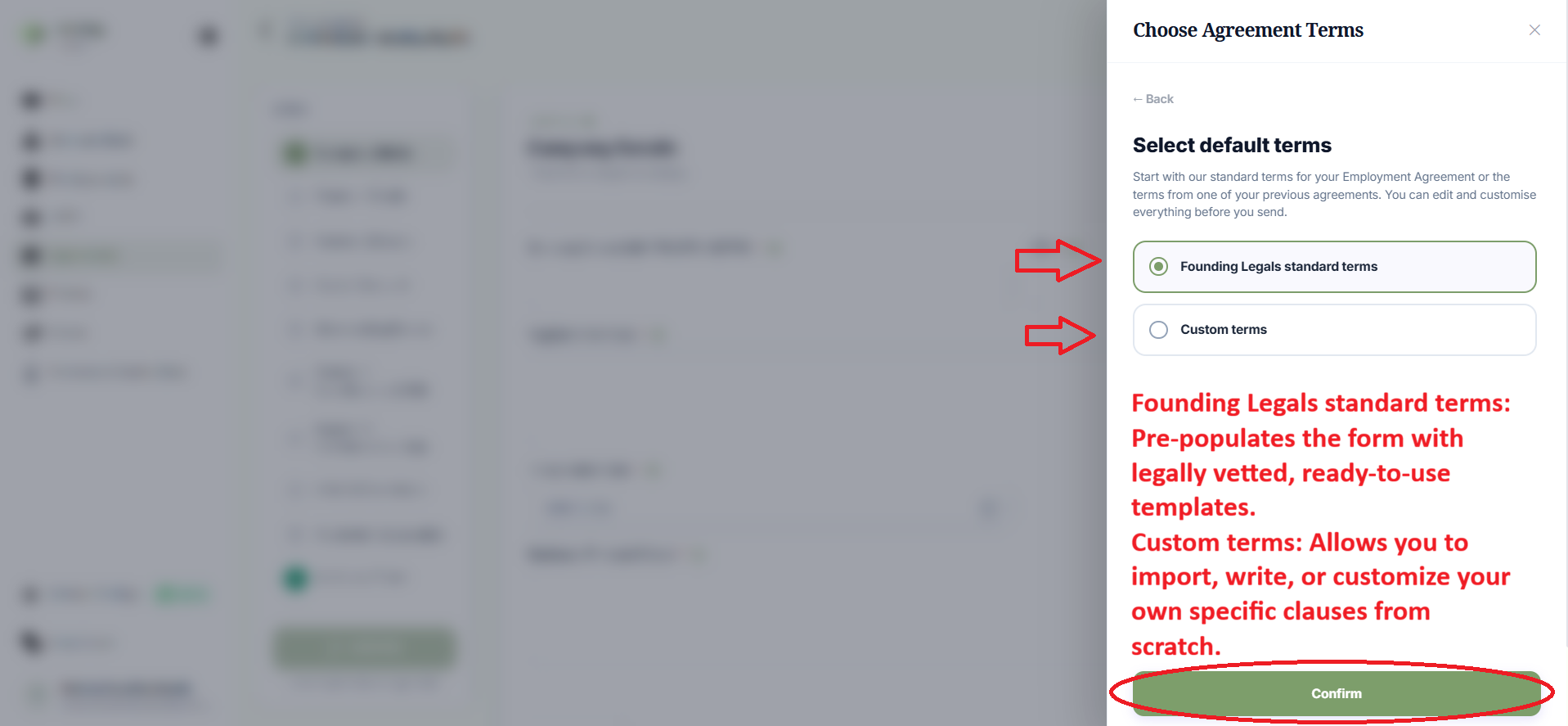
Enter signing place and date: In Step 1, input:
- Execution Place (City): Enter the city where this agreement is executed (e.g., Bengaluru). This determines the jurisdiction and local stamp duty requirements.
- Execution Date: Select the calendar date the agreement takes effect. Month and Year will auto-fill.
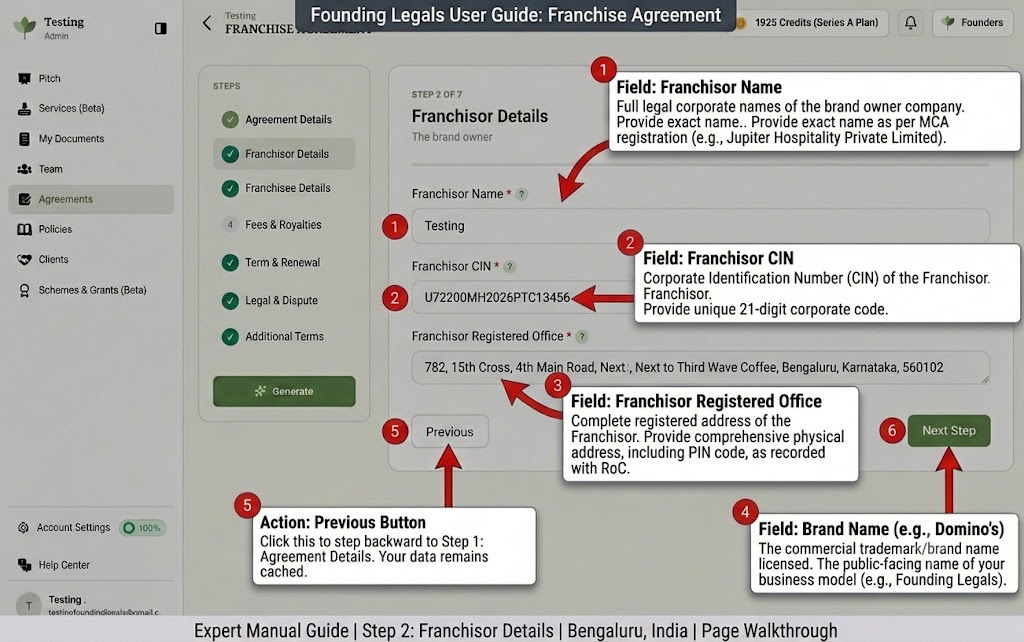
Provide Franchisor legal details: In Step 2, enter:
- Franchisor Name: Enter the official corporate name of the brand owner (e.g., Jupiter Hospitality Private Limited).
- Franchisor CIN: Enter the 21-digit Corporate Identification Number.
- Franchisor Registered Office: Enter the official registered corporate address as recorded with the RoC.
- Brand Name: The public-facing name of your business model or commercial trademark licensed (e.g., Founding Legals or Domino's).
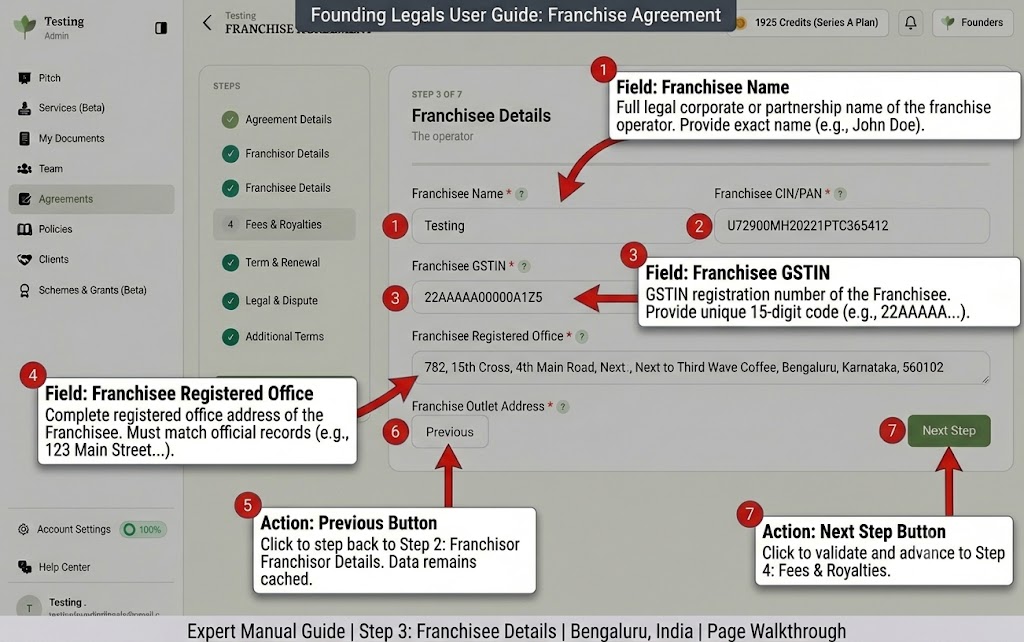
Provide Franchisee registration details: In Step 3, enter:
- Franchisee Name: Enter the official name of the operating company or individual (e.g., John Doe).
- Franchisee CIN/PAN: Enter the CIN for corporate operators, or the individual PAN.
- Franchisee GSTIN: The 15-digit GST registration number of the Franchisee.
- Franchisee Registered Office: Enter the physical registered office address.
- Franchise Outlet Address: The physical address where the franchise store or outlet will operate.
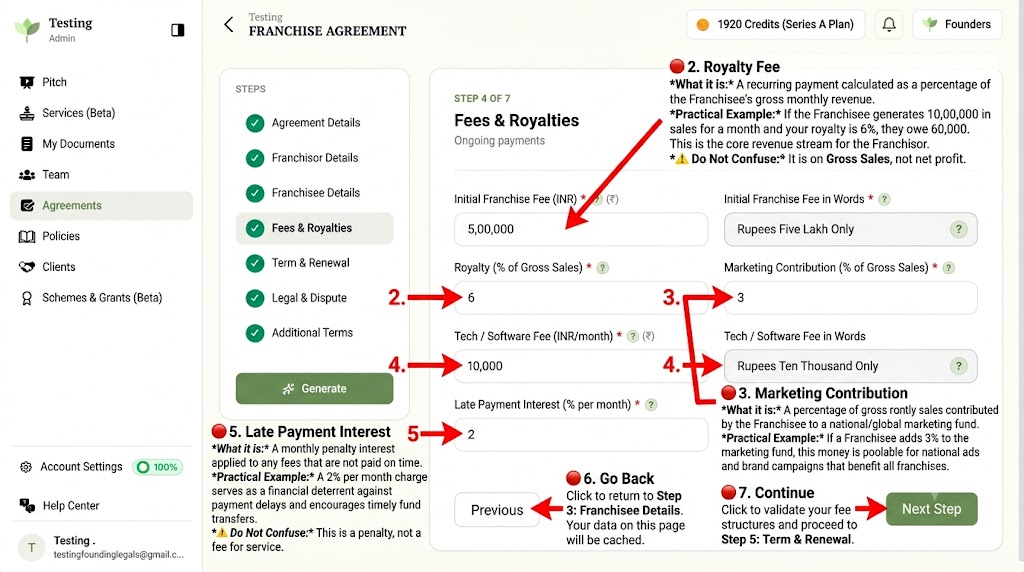
Configure initial fees and royalty splits: In Step 4, enter:
- Initial Franchise Fee (INR): The upfront fee paid by the Franchisee upon execution (e.g., 5,00,000). The words description will auto-fill.
- Royalty (% of Gross Sales): The recurring payment calculated as a percentage of the Franchisee's gross monthly revenue (e.g., 6%). Gross sales are pre-tax and pre-expense.
- Marketing Contribution (% of Gross Sales): A percentage of gross monthly sales contributed by the Franchisee to the national/global brand marketing fund (e.g., 3%).
- Tech / Software Fee (INR/month): Monthly software license fee for accessing core POS or ordering tools (e.g., 10,000).
- Late Payment Interest (% per month): The monthly penalty interest applied to delayed fee transfers (e.g., 2%).
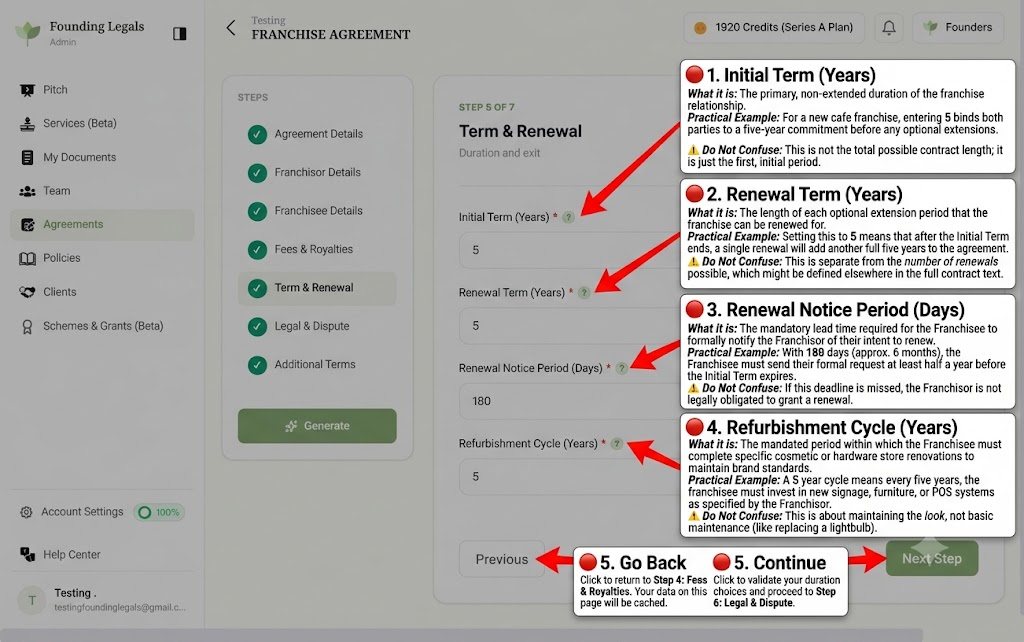
Establish agreement duration and refurbishment standards: In Step 5, enter:
- Initial Term (Years): The primary duration of the franchise relationship before extensions (e.g., 5 years).
- Renewal Term (Years): The length of each optional extension period (e.g., 5 years).
- Renewal Notice Period (Days): The mandatory lead time required for the Franchisee to notify the Franchisor of their intent to renew (e.g., 180 days).
- Refurbishment Cycle (Years): The mandated interval within which the Franchisee must renovate the physical storefront to maintain brand guidelines (e.g., 5 years).
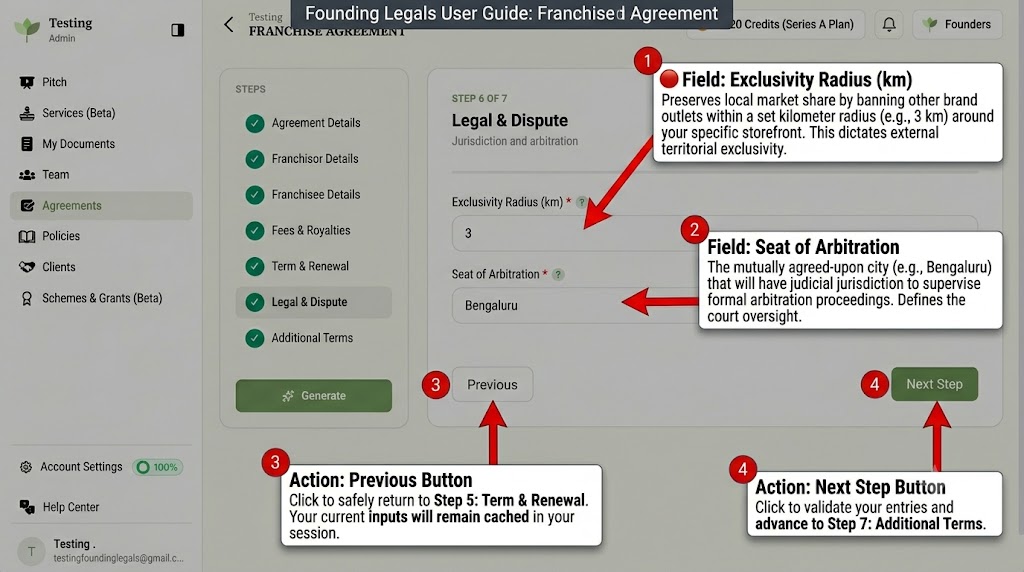
Define market boundaries and dispute resolution: In Step 6, input:
- Exclusivity Radius (km): Banning other outlets of the same brand within a set physical radius around the storefront to preserve local market share (e.g., 3 km).
- Seat of Arbitration: The mutually agreed-upon city (e.g., Bengaluru) that will have judicial jurisdiction over arbitration hearings.
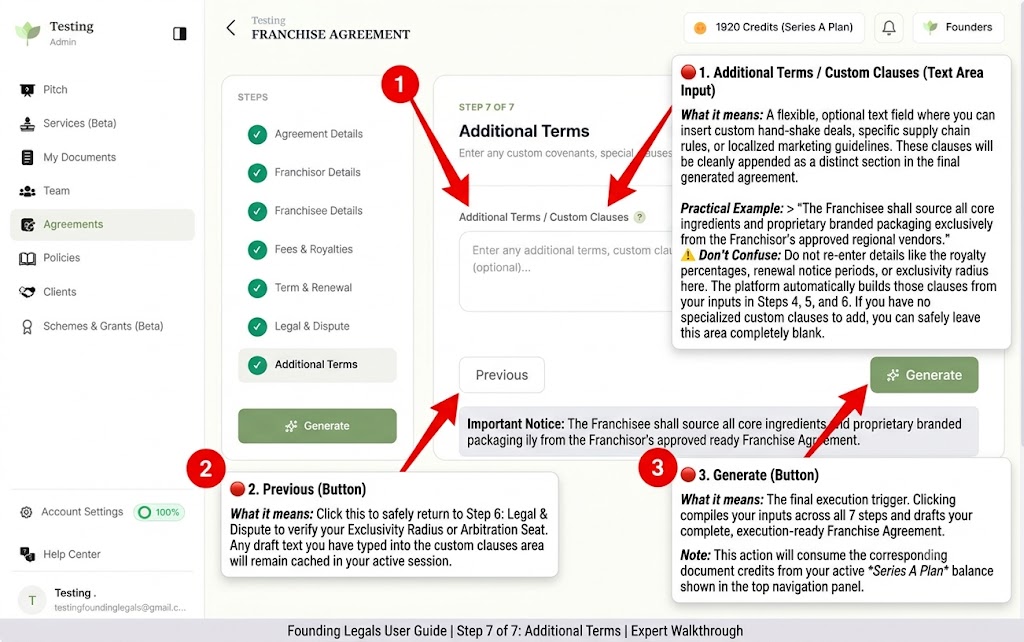
Add custom operational rules and compile: In Step 7, enter any custom clauses (e.g., requiring the Franchisee to source all ingredients/packaging exclusively from authorized regional vendors). Once verified, click Generate to compile the agreement.
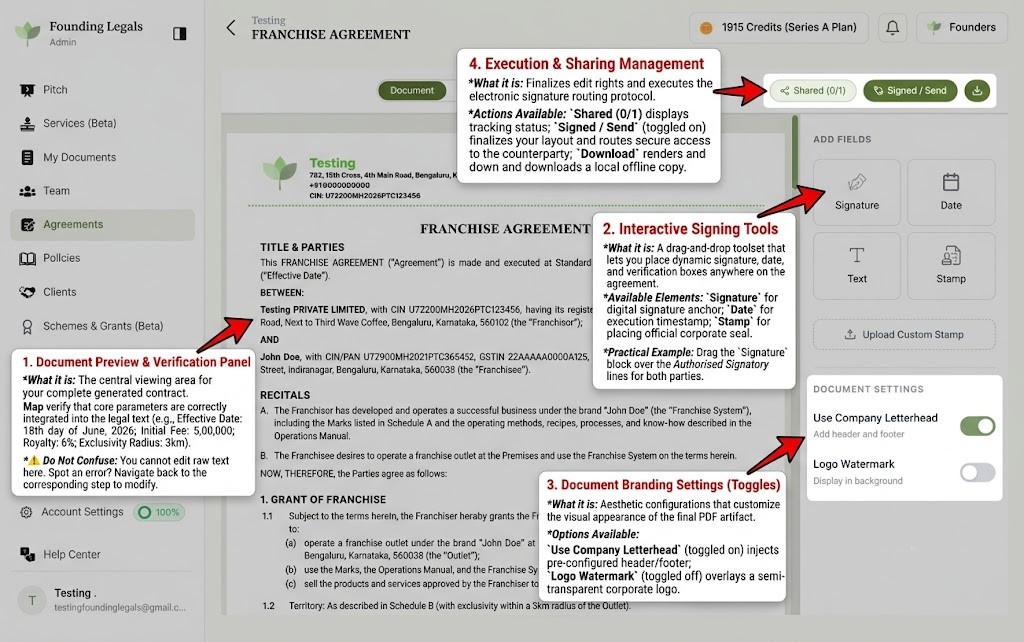
Execute the Franchise Agreement: In the final Document Review screen:
- Document Preview: Verify that all key variables (Effective Date, Initial Fee, Royalty %, Exclusivity Radius) are accurately merged into the agreement text.
- Interactive Signing Tools: Drag-and-drop the Signature, Date, and Stamp fields from the panel onto the signing blocks.
- Document Branding Settings: Toggle Use Company Letterhead or Logo Watermark.
- Execution: Click Signed / Send to execute and route the agreement to the counterparty, or Download to obtain an offline PDF copy.
Failing to register the Franchisee as a "Registered User" with the Trademark Registry under Section 48 of the Trade Marks Act, 1999 can expose the Franchisor to risks of trademark dilution or franchise claims over brand ownership. Always file the registered user application (Form TM-U) within the statutory timelines post-execution.
Franchise royalties and software fees are classified as payments for technical services or royalty under Section 194J of the Income Tax Act, 1961. The Franchisee must deduct Tax Deducted at Source (TDS) at the standard rate (typically 10%) prior to remittance. Inadequate deduction can lead to interest penalties and disallowance of expenditures for the Franchisee.
Refurbishment requirements (e.g., every 5 years) are a major source of franchisee friction. Clearly define that refurbishment costs are fully borne by the Franchisee, but set up a reserve fund mechanism (e.g., reserving 1-2% of monthly sales in a separate capital expenditure account) from Year 1 to ensure funds are available when the cycle triggers.
Quality Assurance
Reviewed by Manoj Kumar Thota
Founder / Developed Founding Legals
About the Author
Manoj Kumar Thota is the creator behind Founding Legals