Complete Showcase of
Startup Legal Agreements
Browse sample templates, key clauses, and generate 21 partner-vetted legal agreements. Starting at just ₹50 per agreement.
Founders' Agreement
Secure your startup's future with a legally binding, partner-vetted Founders' Agreement detailing equity vesting, IP assignment, and deadlock resolution.
Overview & Purpose
A Founders' Agreement is a legally binding contract governed by the Indian Contract Act, 1872 and Companies Act, 2013. It establishes the legal framework between startup co-founders by outlining equity ownership percentages, 4-year vesting schedules (with 1-year cliff), executive designations (CEO/CTO/COO), intellectual property assignment, decision-making vetoes, and exit buyback mechanisms.
Why is a Founders' Agreement Crucial?
Who Needs a Founders' Agreement?
- Co-founders launching a tech startup, D2C brand, or commercial enterprise.
- Early-stage partners preparing for Private Limited incorporation.
- Teams seeking VC funding requiring structured cap table governance.
When Should You Execute It?
- Startup Inception & Co-Founder Onboarding: Before commencing product development or committing capital.
- Prior to Incorporating a Private Limited Company: Aligning equity splits and Director roles ahead of MCA filings.
- Before Pitching Angel Investors & VCs: Demonstrating team alignment and IP assignment readiness.
Real-World Scenarios & Case Examples
Two tech co-founders partnered with a business lead. A 4-year vesting schedule saved the startup when the business lead left after 6 months, allowing the company to repurchase unvested shares for nominal value.
During a ₹5 Crore Seed funding round, VC attorneys audited the Founders' Agreement to confirm 100% codebase ownership was legally assigned to the Private Limited entity.
Types & Scenarios
Understanding contract variations ensures you select the correct agreement structure:
Standard Equal Equity Split Agreement
Co-founders split equity equally (e.g. 50/50 or 33/33/33) accompanied by uniform 4-year vesting schedules and cliff periods.
Ideal for early-stage teams contributing equal capital, time commitment, and strategic expertise.
Role-Weighted & Milestone Vesting Agreement
Equity allocation structured according to individual capital contribution, technical domain expertise, or milestone achievement.
Suited for teams with distinct full-time vs part-time co-founders or primary technology creators.
Founders' Pre-Incorporation Deed
Early-stage agreement executed prior to formal Private Limited incorporation defining initial cash pool contributions and entity setup responsibilities.
Incubation stage startups preparing for MCA registration.
Founders' Agreement vs Shareholders' Agreement (SHA)
| Aspect | Founders' Agreement | Shareholders' Agreement (SHA) |
|---|---|---|
| Parties Bound | Executed solely among the startup co-founders. | Executed between founders, external investors (VCs/Angels), and the company. |
| Execution Stage | Executed at startup inception / pre-incorporation stage. | Executed during priced investment funding rounds. |
| Primary Focus | Focuses on co-founder roles, vesting, IP transfer, and operational effort. | Focuses on investor veto rights, anti-dilution, board seats, and exit preference. |
Key Clauses & Exclusions
Essential terms and contractual provisions included in this document:
| Clause / Component | Clause Summary & Purpose |
|---|---|
| Initial Capital & Equity Split | Defines exact shareholding percentages, initial cash contributions, and share class structure. |
| Vesting Schedule & Cliff | Standard 4-year vesting timeline with 1-year cliff preventing early unvested share retention. |
| Executive Roles & Decision Vetoes | Assigns CEO/CTO/COO titles, daily operating authority, and reserved matters requiring unanimous founder consent. |
| Comprehensive IP Assignment | Unconditional legal transfer of all pre-existing and future intellectual property to the startup entity. |
| Reverse Vesting & Share Buyback | Mechanism enabling the company or remaining co-founders to repurchase unvested equity upon departure. |
| Non-Compete & Non-Solicitation | Covenants restricting departing co-founders from launching competing businesses or poaching team members for 1-2 years. |
| Deadlock Resolution Mechanism | Structured escalation protocol (mediation, Russian Roulette buy-sell, or independent board arbitration) for unresolved disputes. |
Standard Legal Exclusions & Exceptions
- •Personal assets, software projects, or patents developed by a founder prior to the startup's formation and explicitly listed as excluded in Annexure A.
- •Side business activities or passive investments approved in writing by all co-founders.
- •General industry domain knowledge acquired prior to the startup's inception.
Legal Validity & Stamp Duty
Indian statutory acts, court enforceability, and stamp paper requirements:
Enforceability in Indian Courts
Founders' Agreements are fully enforceable legal contracts in Indian civil courts under Section 10 of the Indian Contract Act. Upon incorporation, key provisions (such as share transfer restrictions and ROFR) are incorporated into the Articles of Association (AOA) to ensure statutory enforceability under company law.
- Injunction against Share Transfer: Court order blocking departing co-founders from transferring shares to external parties.
- Specific Performance of IP Transfer: Mandatory court decree compelling execution of IP assignment deeds.
- Equitable Share Buyback Enforcement: Legal enforcement of pre-agreed valuation buybacks for unvested equity.
State-Wise Non-Judicial Stamp Duty Requirements
Execution Procedure
- Step 1: Equity & Vesting Alignment: Co-founders agree on ownership split, 4-year vesting, and executive titles.
- Step 2: Automated Generation: Customize terms on Founding Legals to generate a partner-vetted agreement.
- Step 3: Review & Customization: Meticulously verify IP assignment, departure buyback pricing, and deadlock rules.
- Step 4: Execution & Stamping: Sign digitally via eSign under IT Act Section 10A or wet-sign on state non-judicial stamp paper.
Pricing & Service Options
| Option | Price |
|---|---|
| Automated Instant GenerationStandard partner-vetted Founders' Agreement template. | ₹50 |
| Expert Custom Drafting & AdvisoryTailored clauses for complex multi-founder vesting or international equity structures. | ₹9,999 – ₹19,999 |
Sample Template
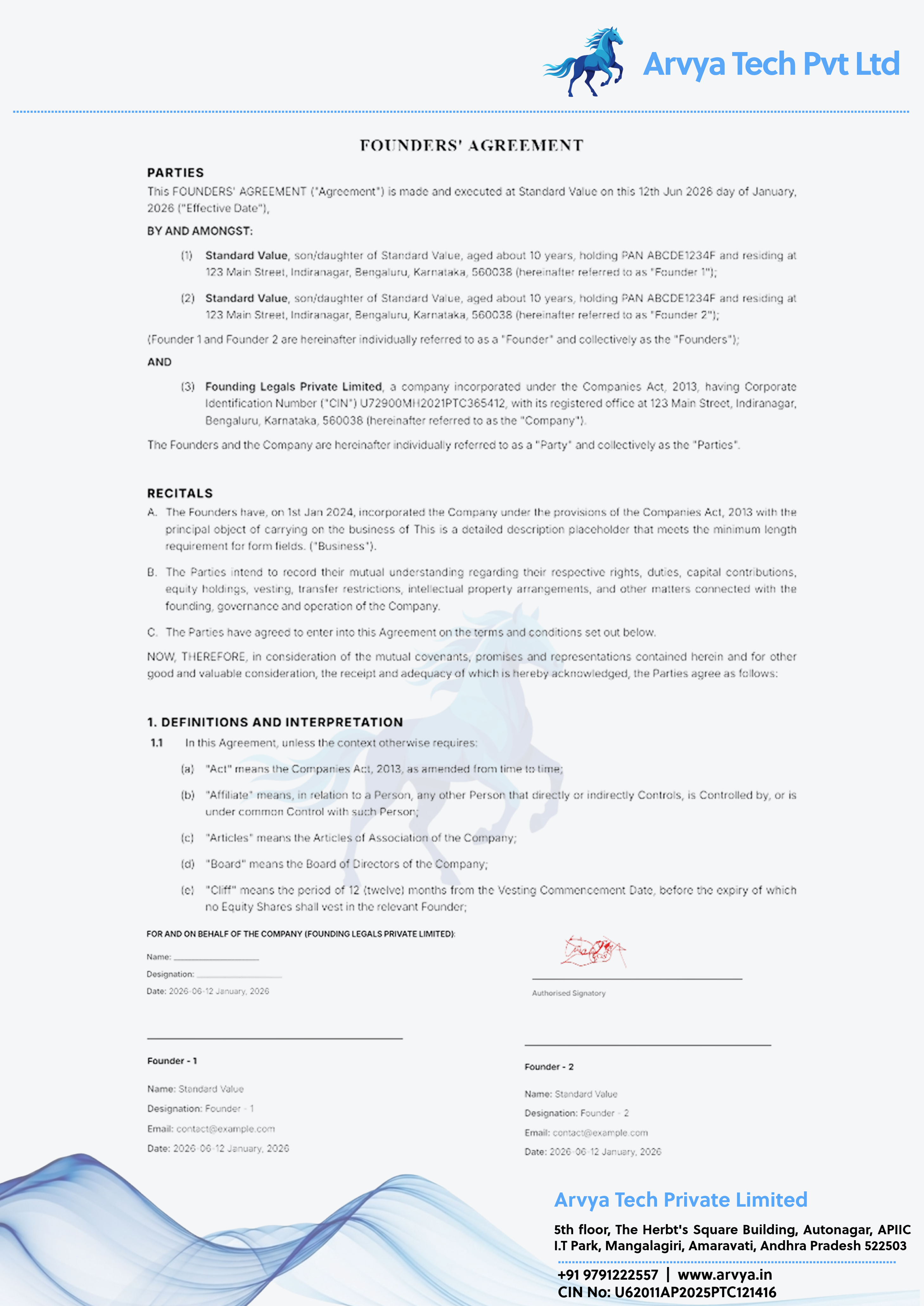
Official partner-vetted visual document template preview (Full A4 Page View):
Frequently Asked Questions
10 questions answeredReady to execute your agreements?
Connect to our dashboard to automatically generate customized, partner-vetted agreements, send them for digital signatures, and manage their status. Starting at just ₹50.