How to Draft and Customize Your Founders' Agreement
Quick Summary
A Founders' Agreement is the legal cornerstone of any co-founded startup. Learn how to define capital structures, equity splits, vesting schedules, and governance rules step-by-step on Founding Legals.
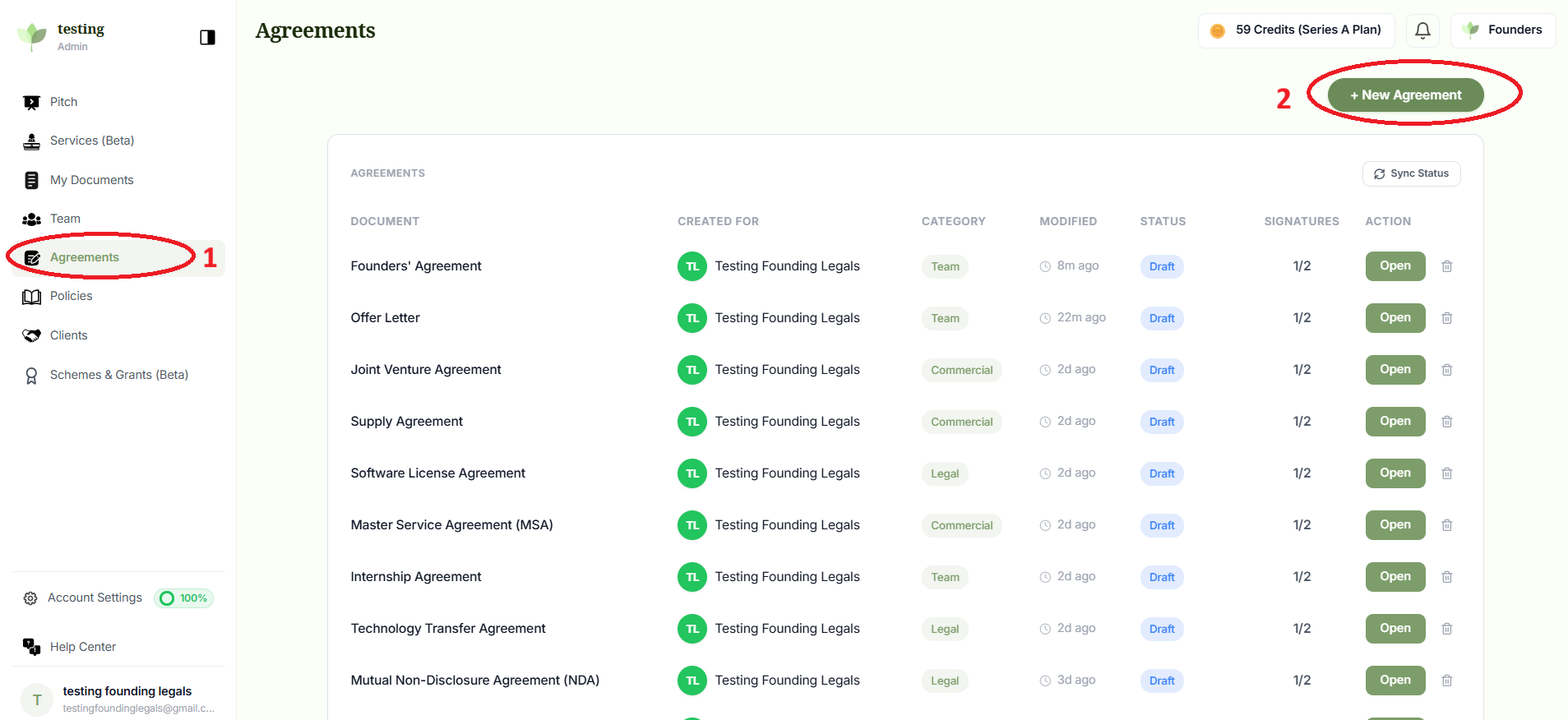
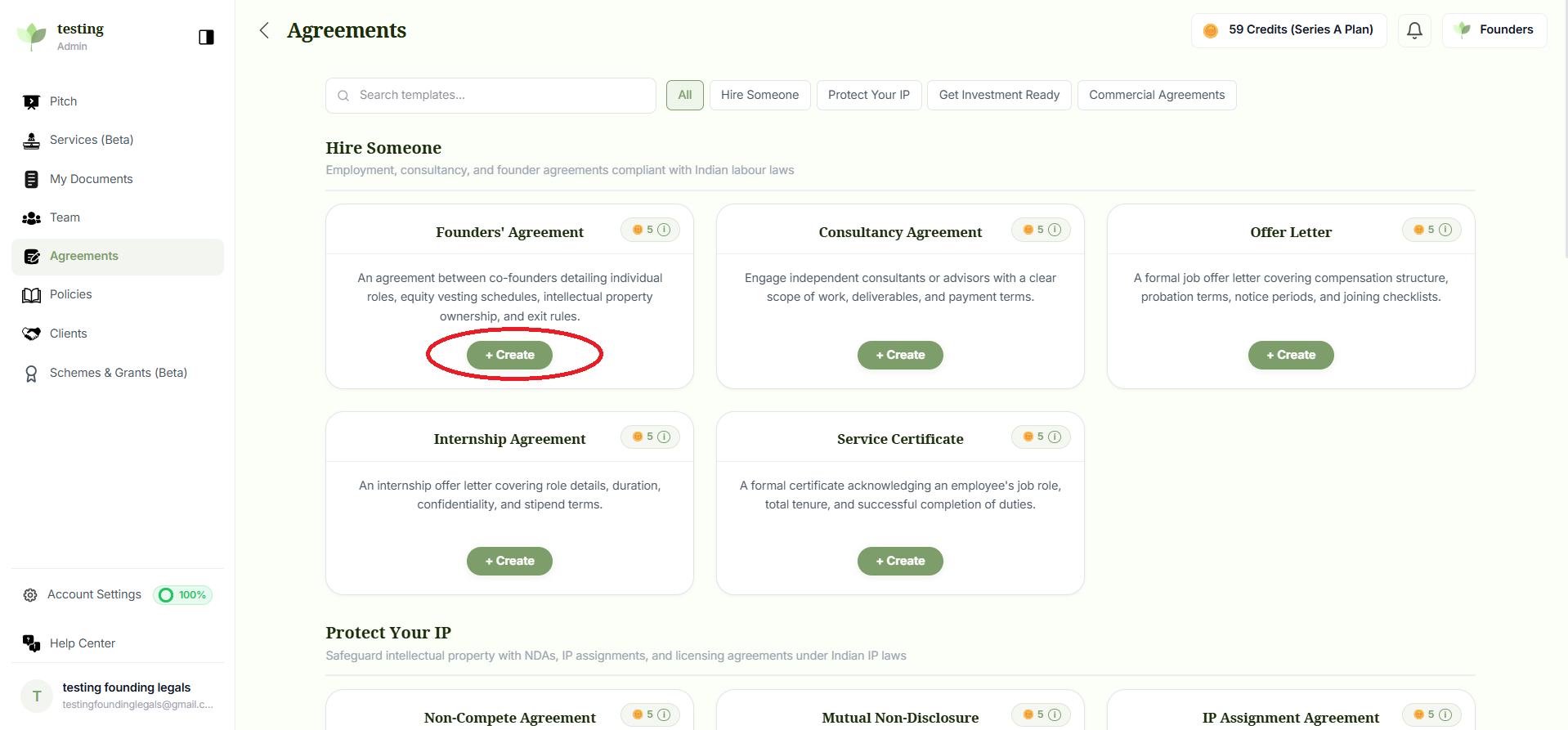
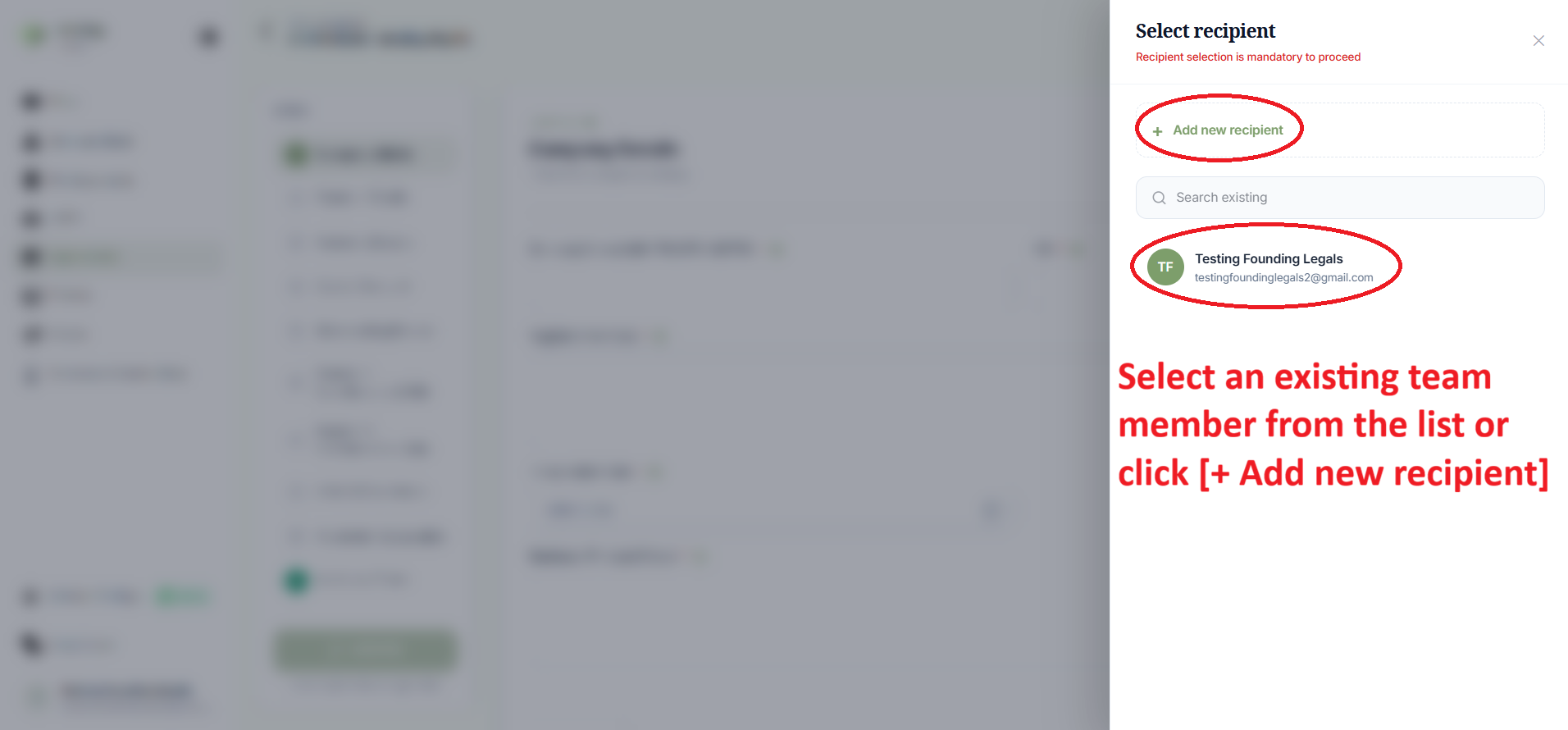
Creating Your Founders' Agreement
Welcome to the step-by-step administrator guide for drafting, configuring, and executing a legally robust co-founder contract on the Founding Legals platform. By documenting share splits, roles, vesting schedules, and corporate governance early, you protect your startup from potential co-founder disputes and align your leadership team.
Step-by-Step Guide to Creating a Founders' Agreement
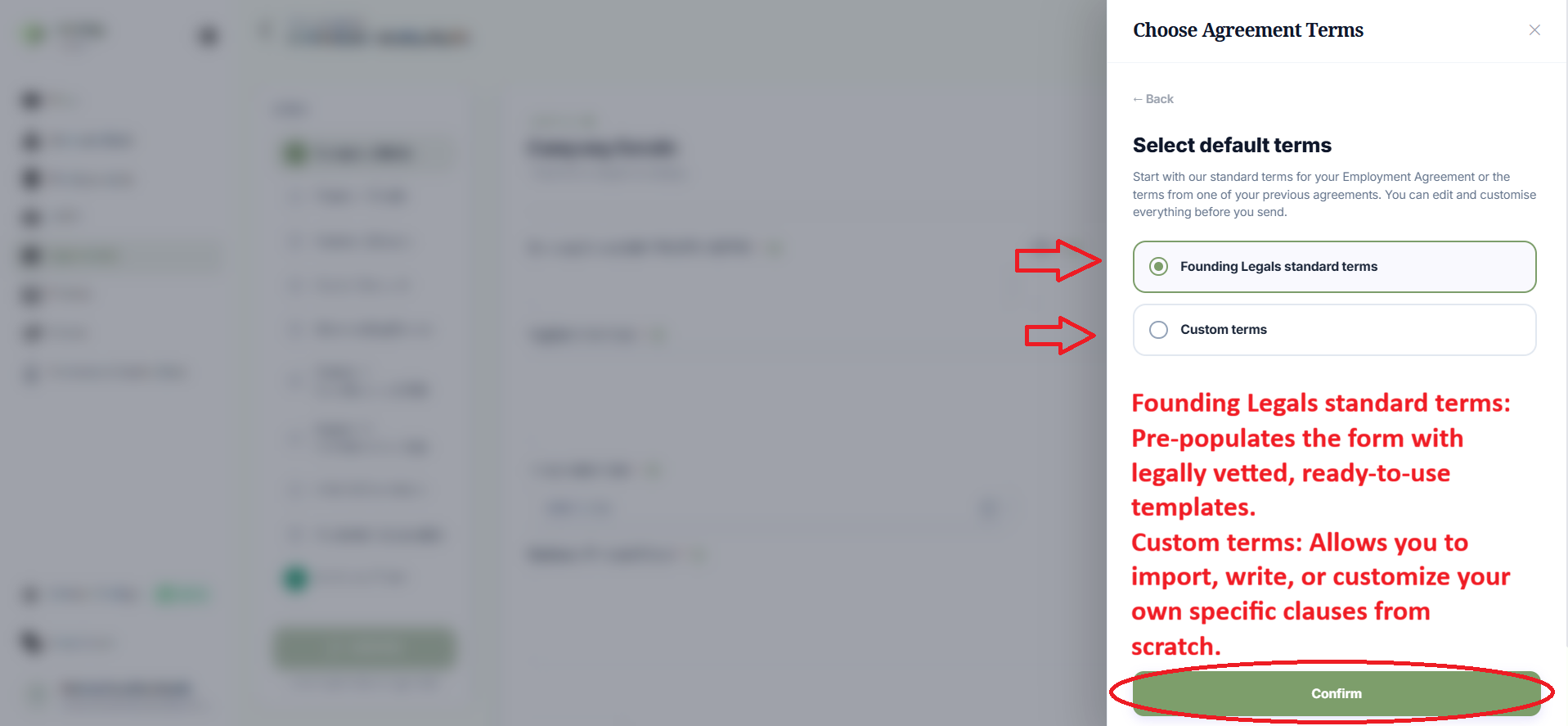
Select your baseline terms: Before entering company metrics, establish your baseline legal framework using the right slide-out panel. Select "Founding Legals standard terms" to pre-populate the contract with legally vetted, standard industry clauses, or choose "Custom terms" if you intend to write or import specialized, custom-tailored legal provisions.
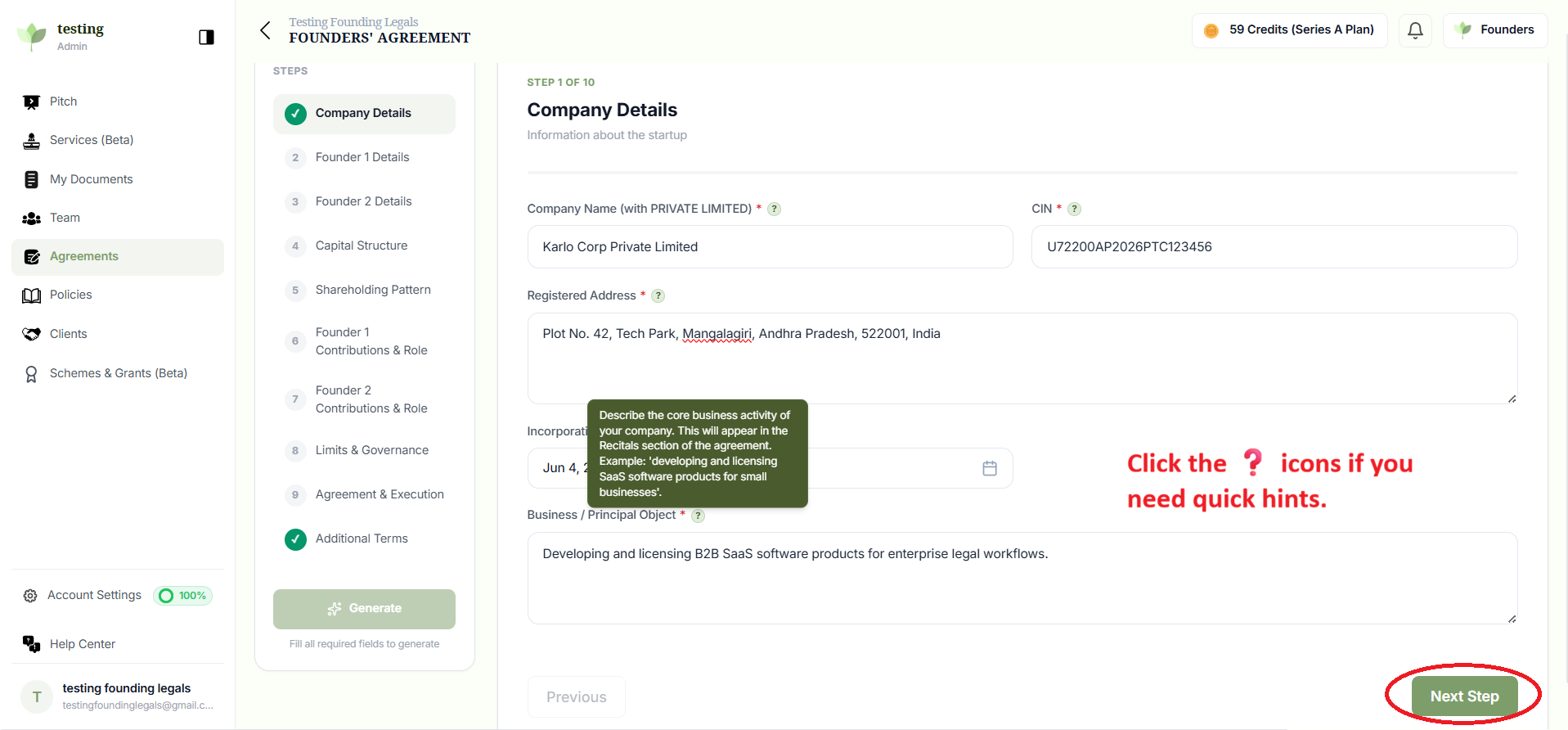
Enter corporate identity details: Provide the foundational corporate identity of your startup as registered with the Ministry of Corporate Affairs (MCA). Click the Question Mark Icon (❓) next to any field if you need a quick tip. You will need to enter the Company Name (with PRIVATE LIMITED), the 21-character alphanumeric Corporate Identification Number (CIN), registered address, incorporation date, and a short business object description.
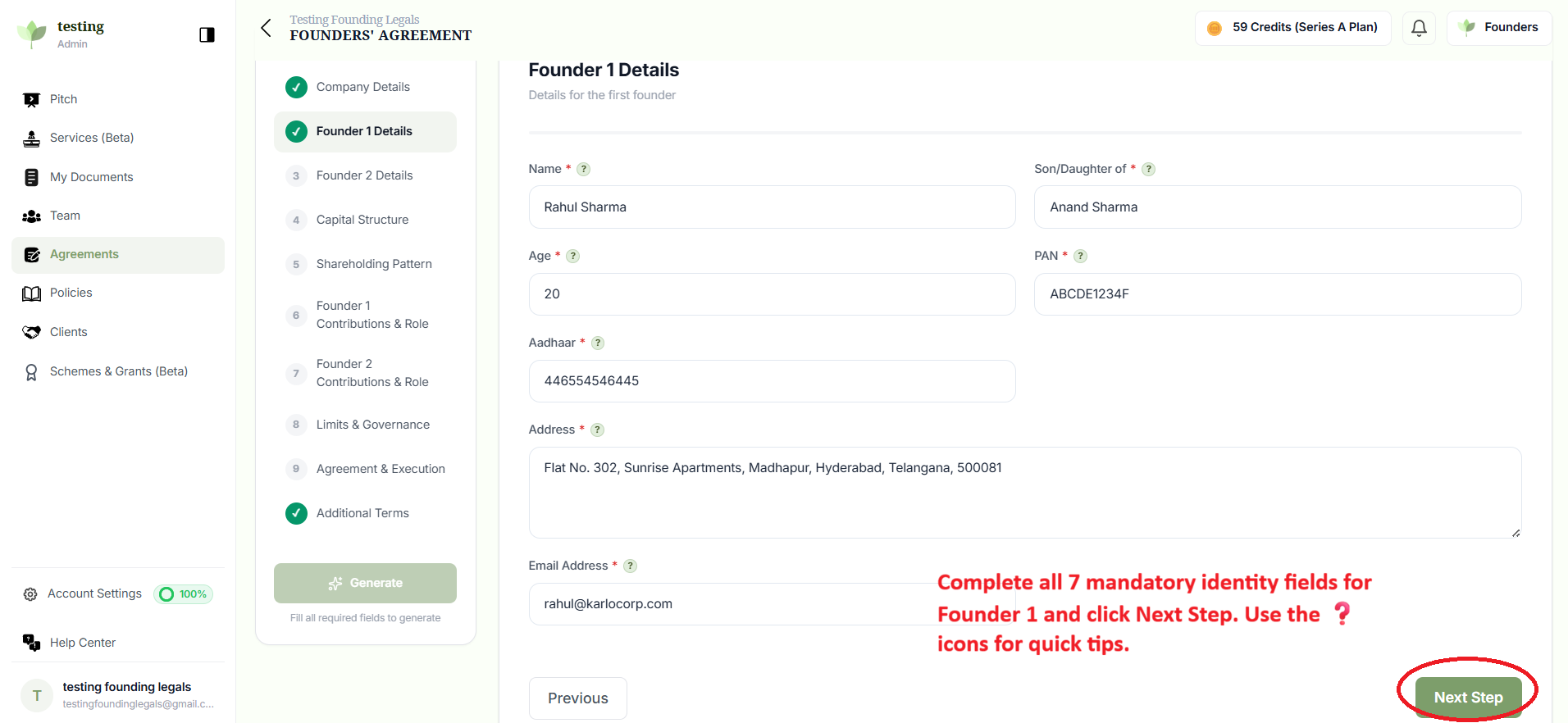
Input Founder 1 Details: Fill in the legal identification fields for Founder 1. Enter their full legal name exactly as it appears on their PAN card, parentage, age (must be 18 or older), PAN number, Aadhaar number, permanent address, and active notification email address.
Input Founder 2 Details: Fill in the identical legal identification fields for Founder 2. Enter their name, parentage, age, PAN number, Aadhaar number, permanent address, and active notification email.
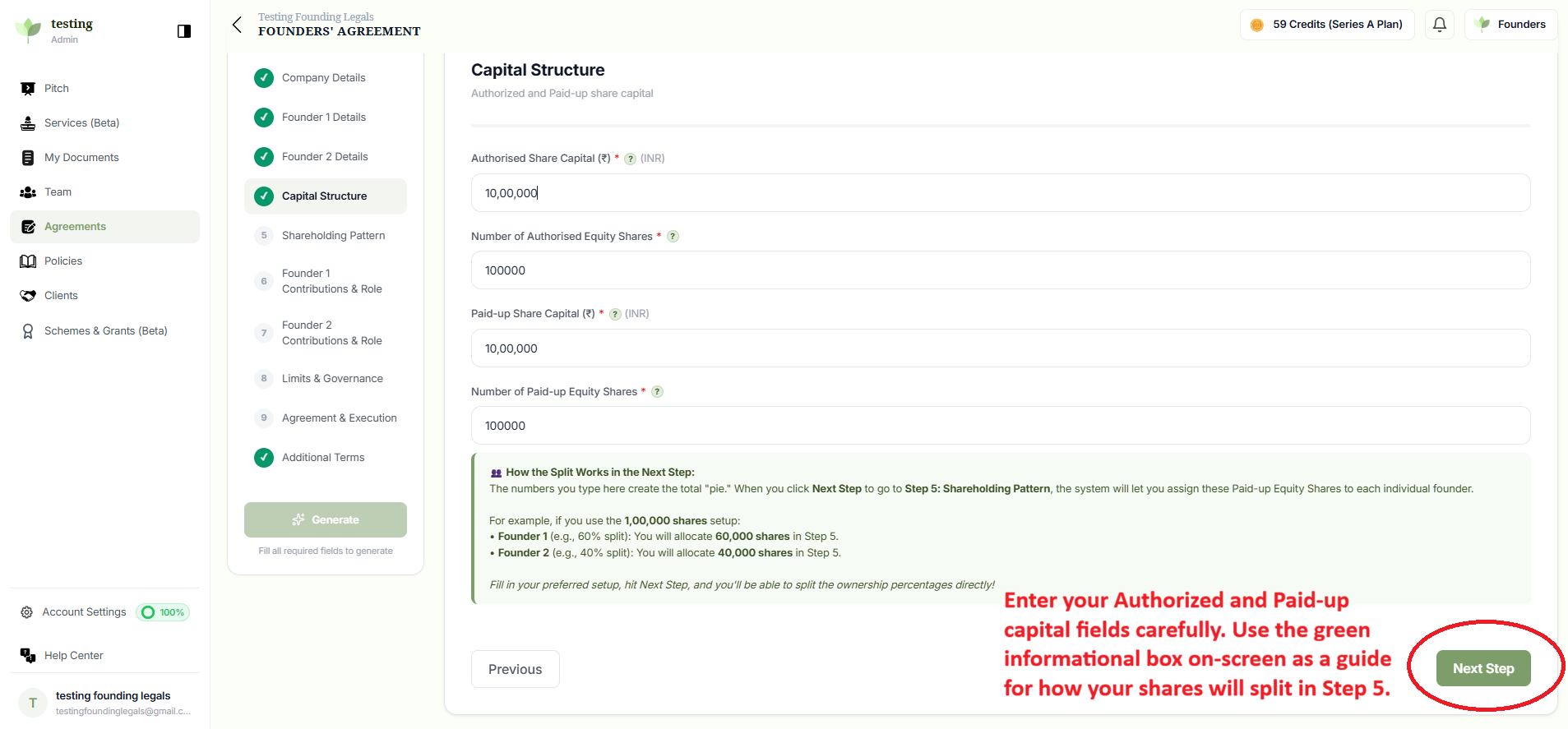
Define equity boundaries:Define your startup's authorized and actual paid-up equity limits. Enter the Authorised Share Capital (₹) representing the maximum monetary cap your company can legally issue as stated in your MoA, and the Paid-up Share Capital (₹) representing the total capital contributions paid by founders so far.
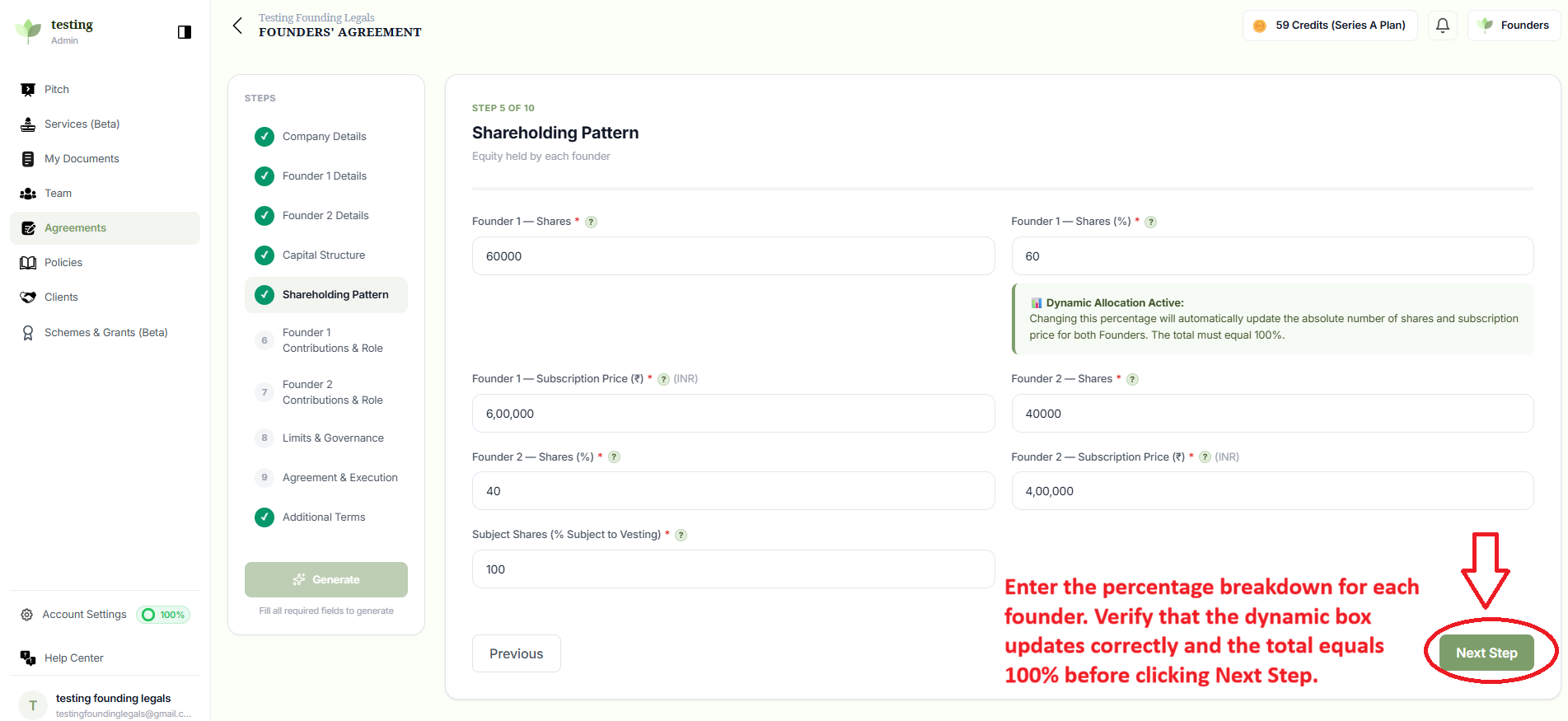
Allocate equity and vesting: Allocate your equity split and establish vesting conditions. Enter the ownership percentage for Founder 1 and Founder 2. The combination must equal exactly 100%. You can also select the percentage of shares subject to vesting (standard startup practice is 100% vesting over 3 or 4 years). Changing any percentage automatically updates the respective share counts and subscription prices in real time.
Define Founder 1 Role: Select the official designation (e.g., CEO, CTO), and detail key daily responsibilities. You can also specify pre-incorporation expenses to be reimbursed and list any intellectual property or non-cash assets contributed to the company by Founder 1.
Define Founder 2 Role: Complete the matching role profiles, IP assignments, and pre-incorporation expense details for Founder 2 to ensure equal clarity on operational roles.
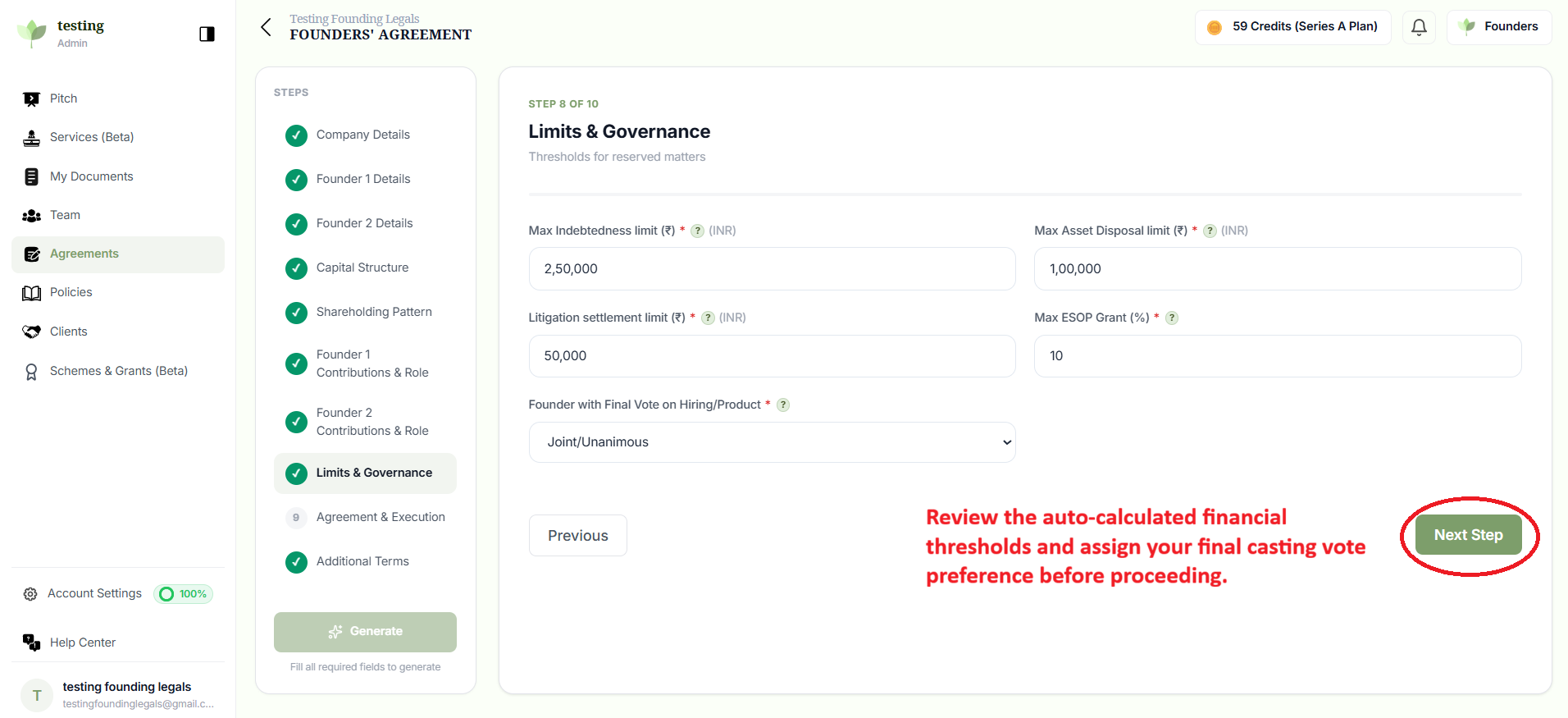
Set unanimous approval thresholds: Set financial and operational thresholds to determine when unanimous founder approval is required. Define the maximum limits for indebtedness, asset disposal, litigation settlements, and maximum ESOP pool grants. Select who holds the tie-breaking casting vote on split decisions.
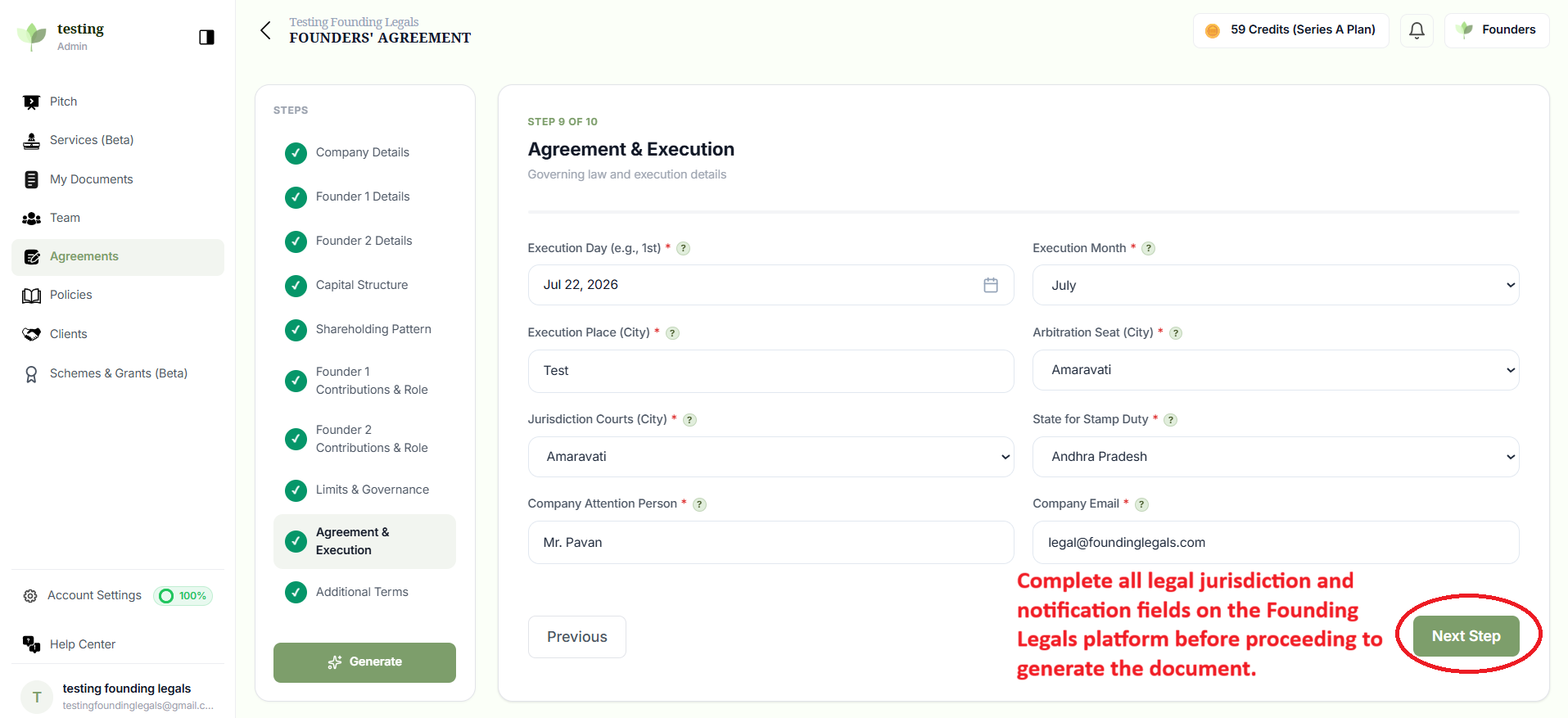
Define legal jurisdiction: Define your signing date, place of execution, and the arbitration seat (Arbitration and Conciliation Act, 1996) and jurisdiction courts. Select the state for stamp duty calculation and specify attention persons for corporate notices.
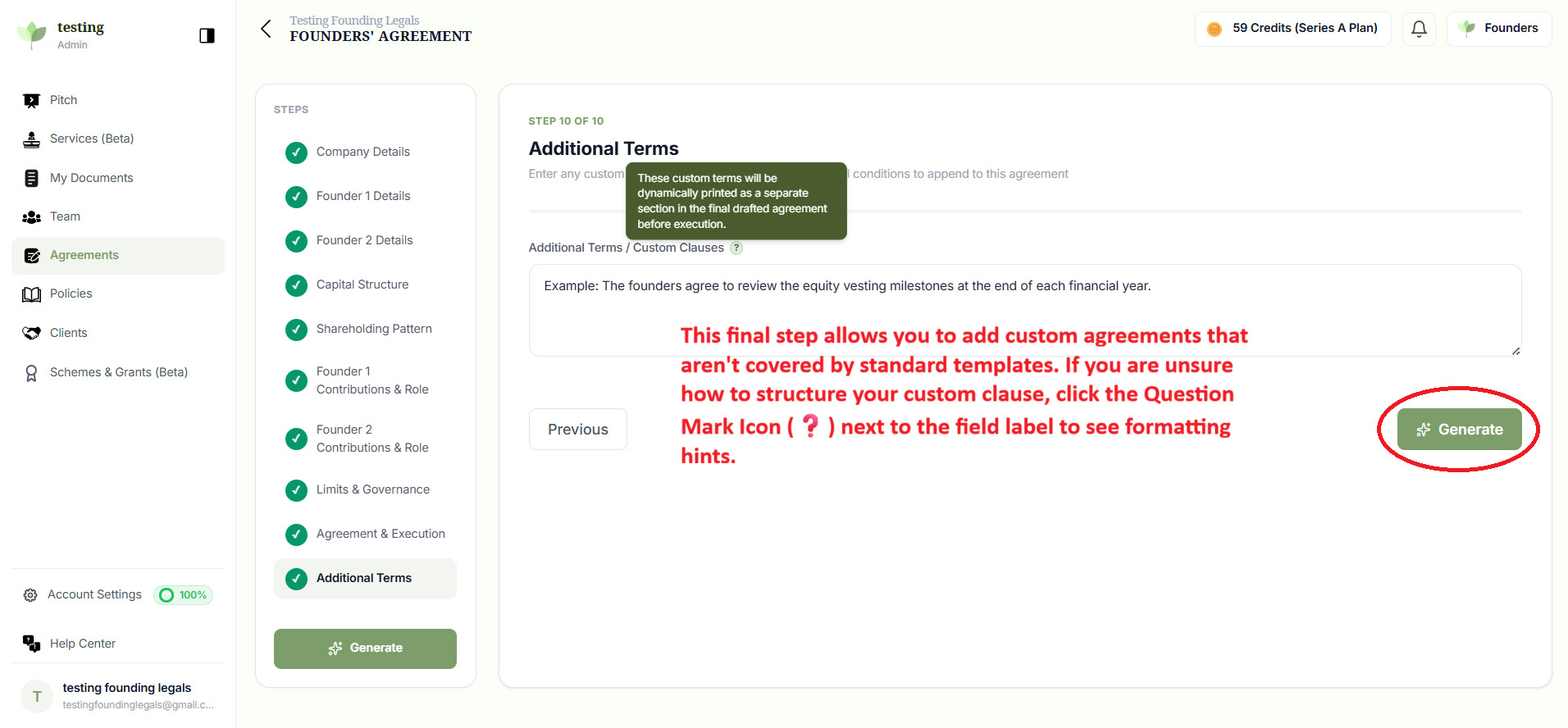
Compile and Generate: Add any custom legal clauses if needed. Verify that all 10 items in the left-hand progress sidebar display a green checkmark (✓). Check your token balance in the top-right and click the green "Generate" button to compile your details.
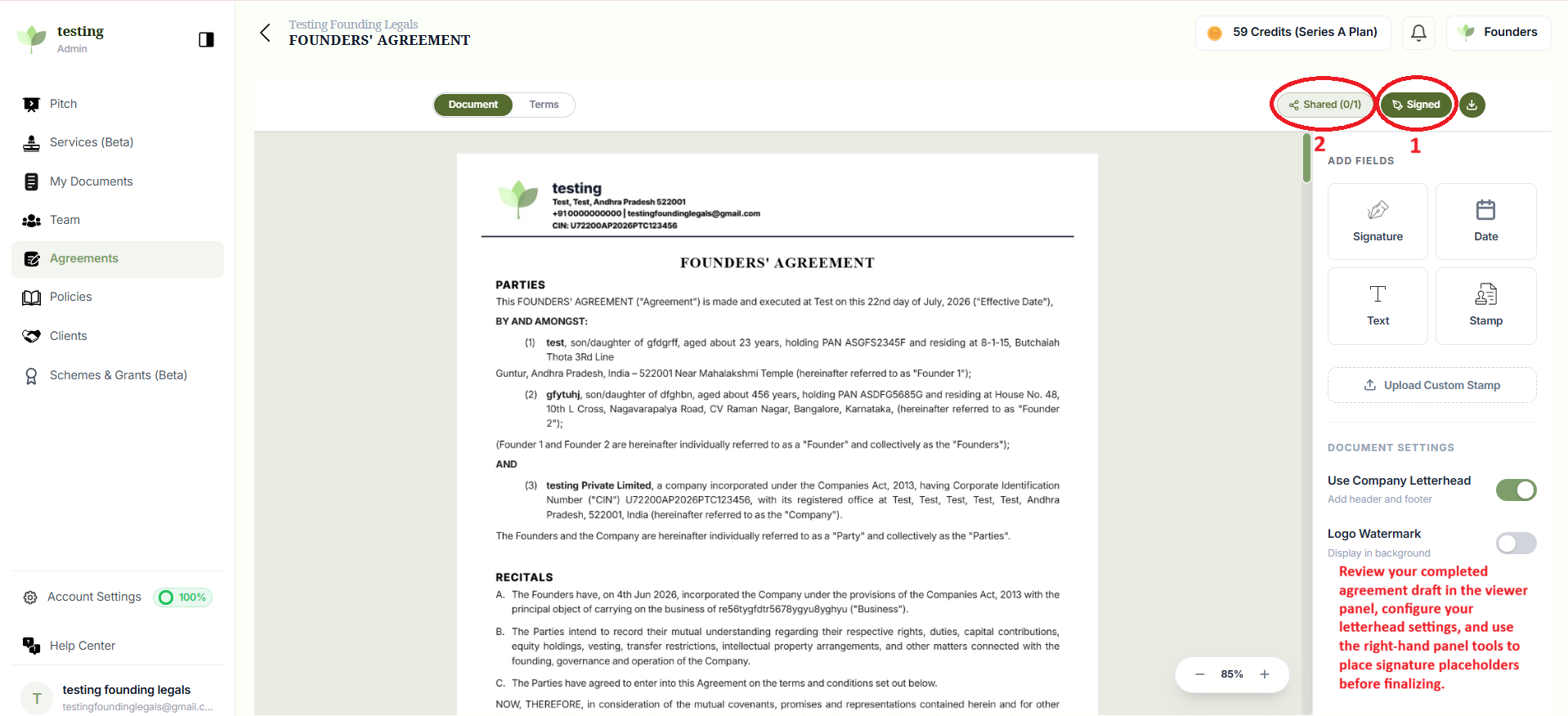
Format and Sign: Once generated, the system opens your interactive live contract document viewer. Use the "Add Fields" right panel to drag and drop signature placeholders, date lines, or corporate stamp fields. Use the settings panel to toggle your branded company letterhead or logo watermark on or off.
Co-founder equity should always be subject to a vesting schedule (such as a 4-year vesting schedule with a 1-year cliff). If a co-founder leaves the company early, unvested shares can be repurchased by the company or remaining founders at face value. Executing a founders agreement without vesting rules leaves the company vulnerable to dead equity issues.
Under state-specific stamp acts, a founders agreement must be stamped with appropriate non-judicial stamp duty to be admissible as evidence in court. Choose the correct execution state during the drafting process to ensure Founding Legals calculates the correct stamp duty denomination.
Quality Assurance
Reviewed by Manoj Kumar Thota
Founder / Developed Founding Legals
About the Author
Manoj Kumar Thota is the creator behind Founding Legals